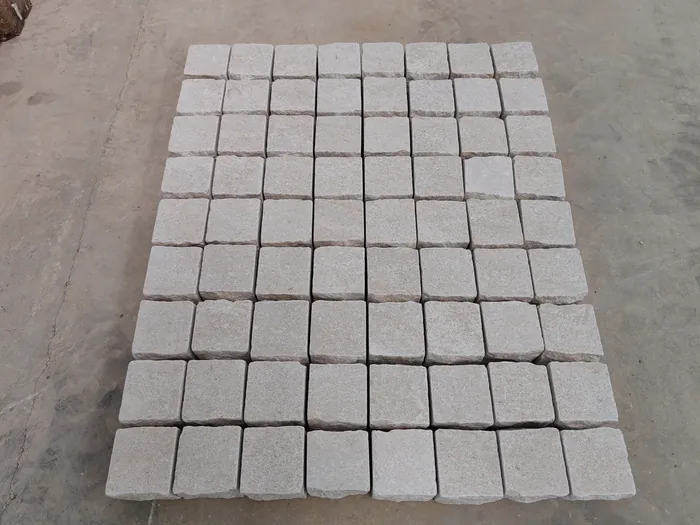
Ground plane
Pavers & flagstone
Driveways, walkways, terraces and pool decks. Cut to format or laid as flagstone and puzzle patterns, in the thickness the load asks for.
 Send the drawings
Home / Service / Custom hardscape
Custom hardscape
Pavers, copings, steps, pool surrounds, flagstone. Block or slab, sourced at the source, cut to format, finished for the outside, and crated for the order it installs in. Not catalogue tile pulled from a stock list. The worked stone, made to your scope, delivered install-ready.
We do not pour the base or set the stone. We deliver the right stone, at the right format, ready to lay.
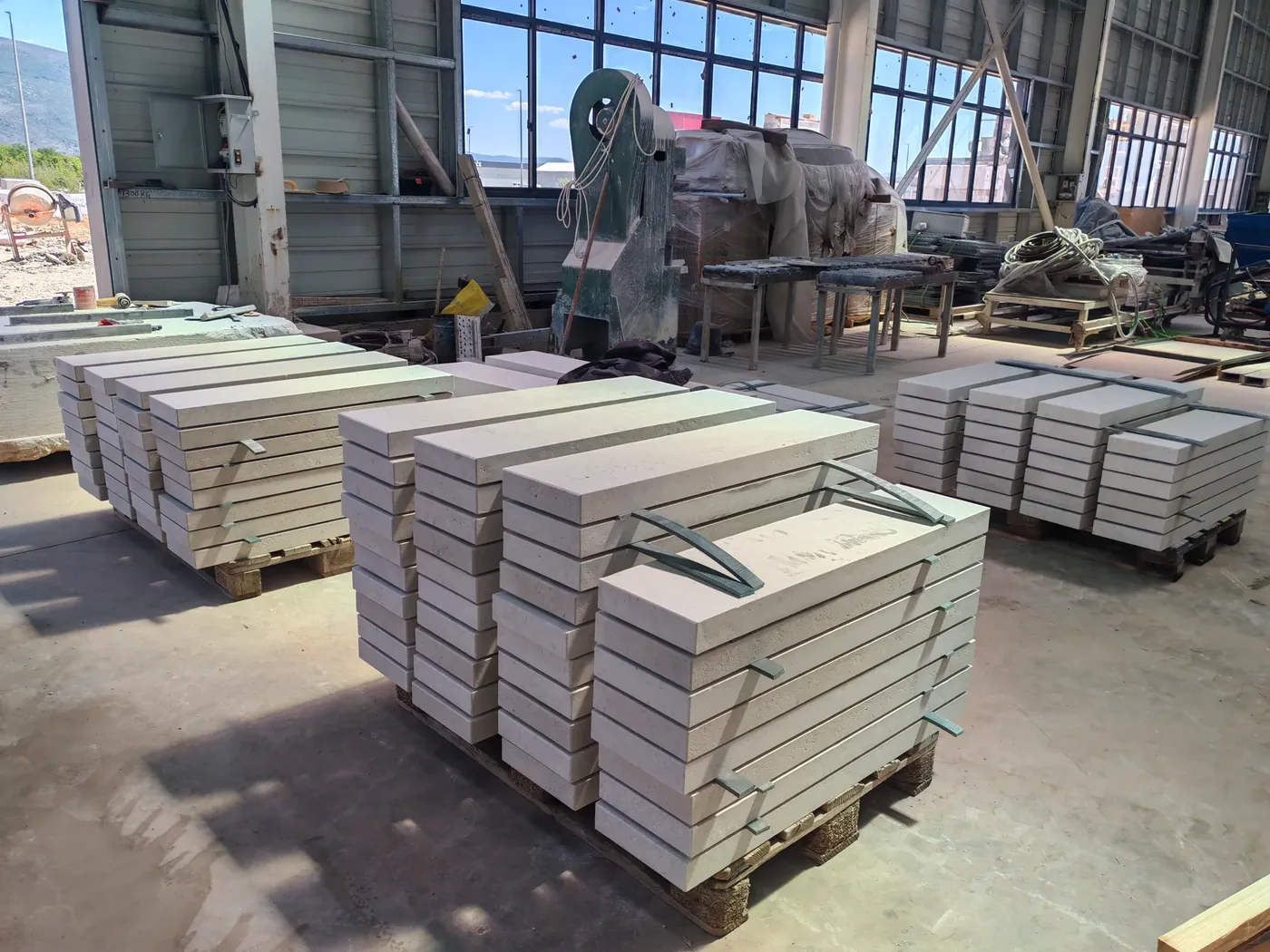
What we mean by custom hardscape
Hardscape is the stone you walk on and live around: the ground plane and the elements that frame it. Custom means cut to your format and finish, not picked off a tile chart. We produce the full vocabulary in a single material, so the run reads as one language from the first tread to the last border.
Ground plane
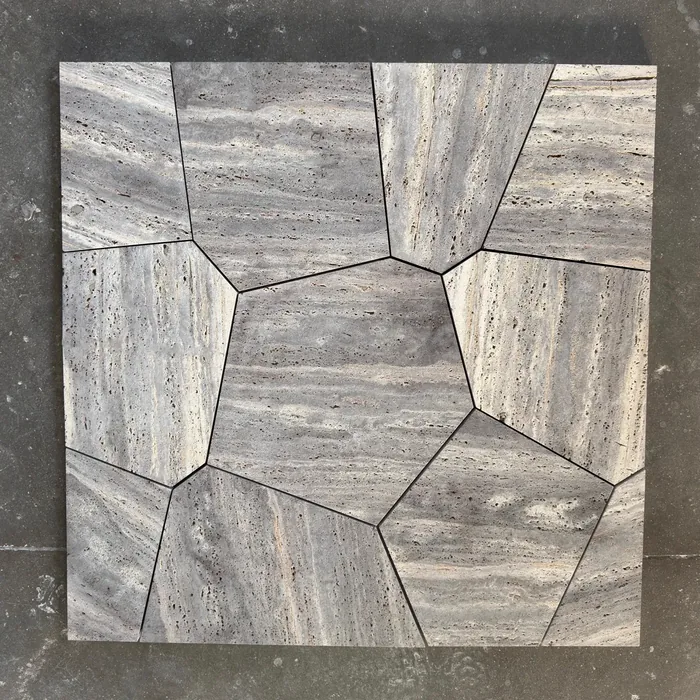
Driveways, walkways, terraces and pool decks. Cut to format or laid as flagstone and puzzle patterns, in the thickness the load asks for.
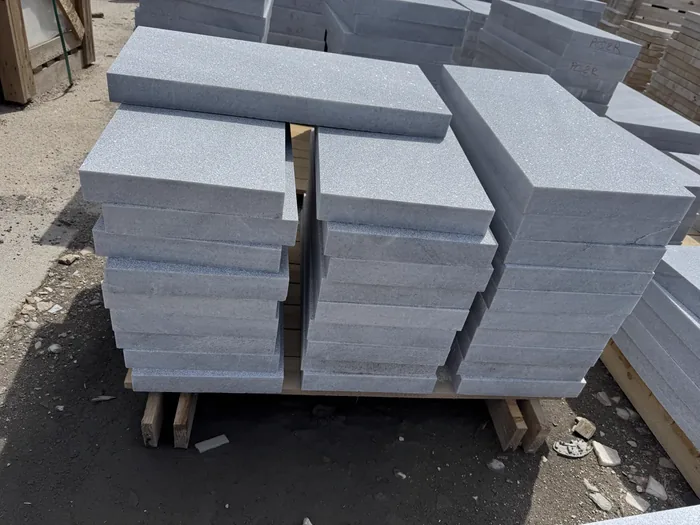
Edges & verticals
Pool copings, wall caps, steps and treads with engineered nosings, drips and a single unified profile so the edges read coherent across the whole site.
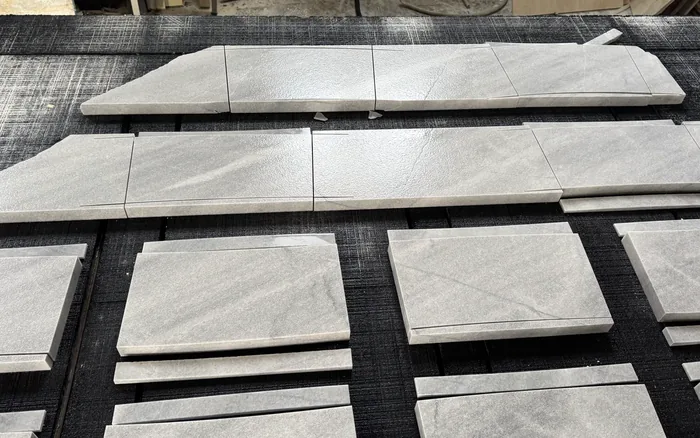
Water & feature
The full perimeter system around water: surround, coping and border, matched in tone and finish to the deck they meet.
Built elements
The designed pieces: fountain cladding, monolithic planters, balustrades and the one-off geometry a drawing calls for, cut to size and dry-laid before it ships.
What we deliver, what we don't
We carry the stone from the quarry to a crate at your port. The ground it sits on, and the hands that set it, are the contractor's. The line is drawn before the first quote, so nobody discovers it on site.
Quarry sourcing, cut to format, the finish the zone needs, and export crates engineered for install. The worked stone, made to your drawing.
AlimontaFreight, customs clearance and inland haul. Ours as a separate line if you want it carried, never aggregated into a hidden rate.
Your scope, or ours as a lineCompacted base, setting bed, jointing sand, sealing and the install itself. The general contractor's package, on site.
GC / clientWe do not pour the base, supply the bedding sand, or set a single piece. We deliver the right stone at the right format and finish, QC'd and crated by zone. One accountable partner for the material, a clean handoff to your crew.
Built for the outside
A floor inside forgives a lot. A driveway in a freezing climate does not. Exterior stone is a durability decision before it is an aesthetic one, and the method to make it well is standardized. We read a candidate material against the tests that decide whether it lives thirty years or comes back as a claim.
Water the stone does not absorb cannot freeze inside it. Low absorption is the first number we read: a dense stone with very low absorption clears most exterior risk before any other test. A porous stone has to prove itself.
Where it freezes, water trapped in the pores expands and fractures. The read that matters is not pass or fail, it is how much flexural strength the stone keeps after the cycles. We ask for the data before we promise a cold climate.
Trafficked and wet zones need grip and wear resistance. The finish is chosen for that: flamed, split, sanded, tumbled or brushed, so the surface holds underfoot and does not polish out in a lobby or a pool deck.
A walkway and a driveway are different problems. Thickness follows the load: lighter for foot traffic, heavier for vehicular, on a base sized to match. Thickness also drives weight, which drives the containers, which drives the freight.
This is also why, outdoors, a dense low-absorption grey limestone often outperforms a soft veined marble. A calcitic marble can bow and lose strength under repeated sun and wet cycling, while a dense, low-absorption stone holds its shape and its color across a very large run. When a drawing names a stone for its look that will not survive the environment, we say so and re-source a denser look-alike, using the finish as a color lever: a sandblast and brush can carry a greige to grey without changing the stone, and you approve a real sample before anything commits. We say what the method supports, never a number we cannot stand behind.
Exterior travertine
Resin breaks down outdoors, so exterior travertine is not resin-filled on the face. The cavities are packed with cement in the workshop, the exposed face is kept resin-free, and the back is reinforced with resin and mesh, then cured before the pieces are cut. Cement filling is slow, careful work that effectively one workshop in the district does well, which is the real lead time on a travertine deck or facade. We put that on the schedule up front instead of letting it surface at the dock. On site the joints are grouted, so the exposed face has no resin to yellow or break down outdoors.
Details we cut
Hardscape lives or dies on its edges. The section through a paver, the profile of a coping, the drip under a nosing, the texture of a finish: these are the details that read as quality, or read as a problem. We draw them, agree them, and prove them before production starts.
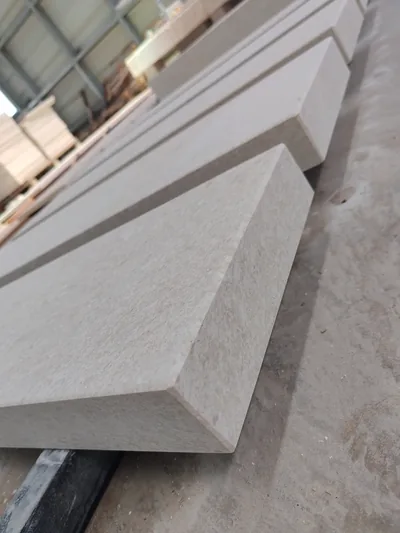
The stone paver is ours, cut to format and finish at 30 to 50 mm. The compacted base and setting bed below it are by others. We draw the interface so the boundary is unmistakable.
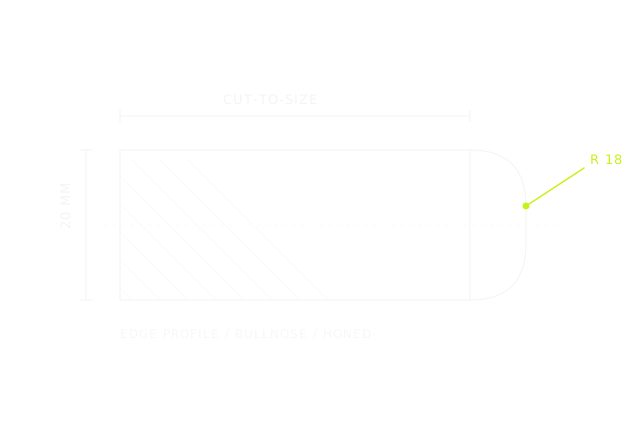
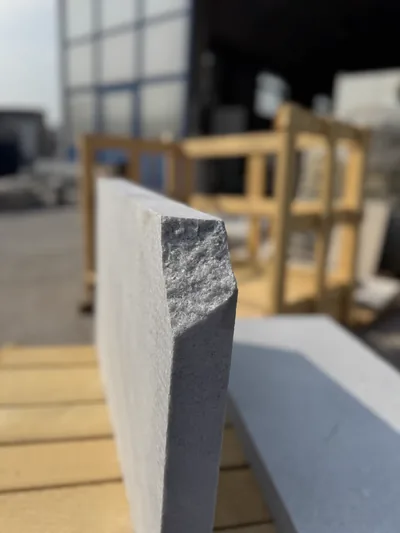
A bullnose pool coping and a step nosing with a drip kerf, so water sheds off the edge instead of tracking back under the tread. Dimensioned and unified across the site.
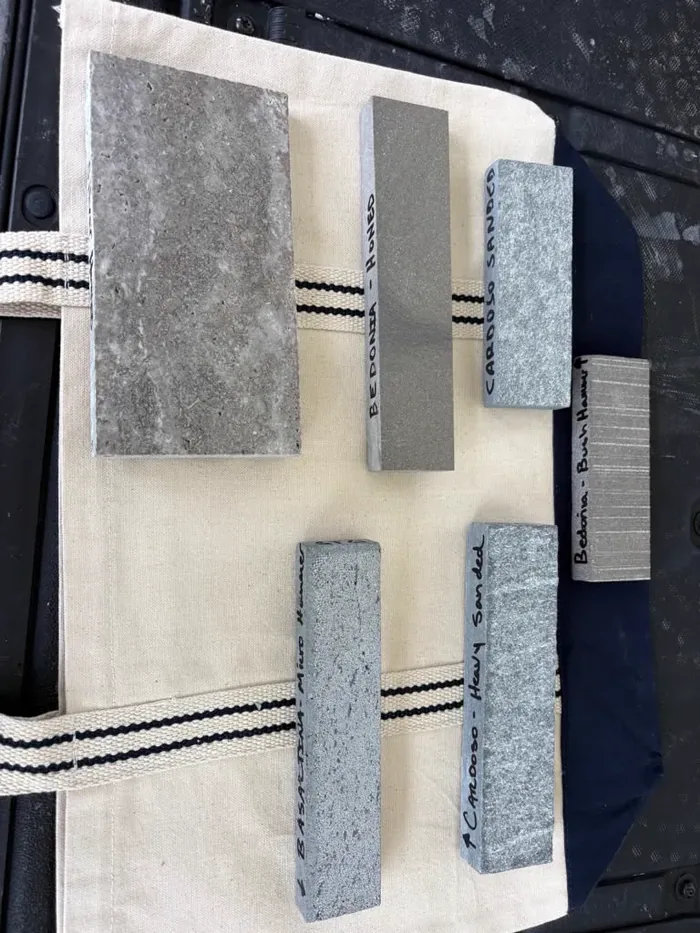
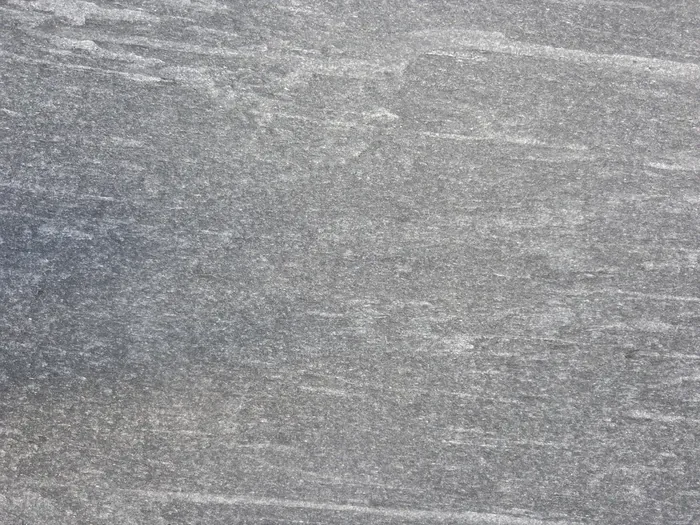
Flamed, split, sanded, tumbled, brushed. The finish is selected for the zone, grip and wear where it is wet and walked, and matched to a sealed master sample so every shipment reads the same.
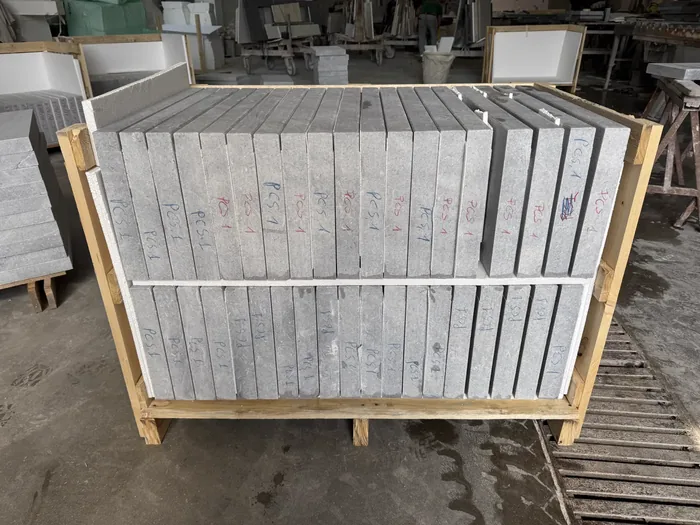
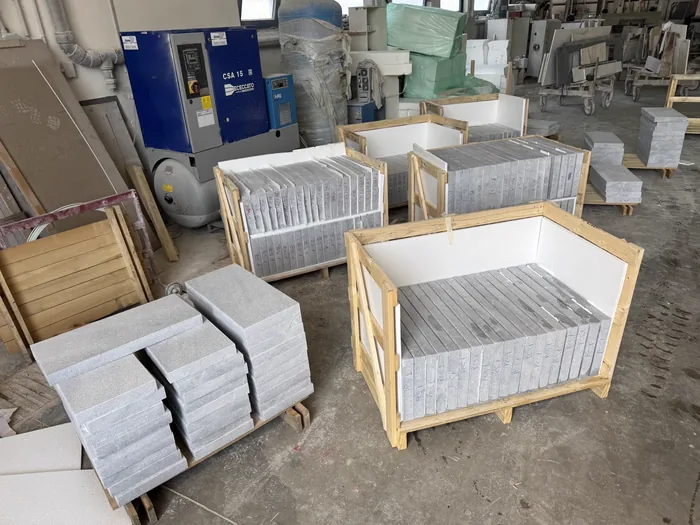
Crates are tagged to the install zone, not the piece type. Zone A1 lands first, A2 next, with gross weight planned per 20-ft container so the crew stages by area and sets stone.
The edge library
The edge is where hardscape reads as custom or reads as catalogue. One profile language runs across copings, treads and borders, dimensioned in centimeters and inches, with a drip kerf wherever water needs to let go of the stone.
Thickness 2, 3 or 5 cm by the load, dimensions always in centimeters and inches. Custom sections run "per drawing": send the architect's profile and we cut that, not our nearest standard.
Engineered crating
On a large hardscape package the real risk is a quiet logistics error: a mixed crate, a heavy piece in the wrong order, a count that drifts between the cut list and the crate. We organize crates by installation area, with traceability from cut ticket to crate to container, and a packing list audited before each load.
Crates carry the pieces for one install area, in the order the crew needs them, so nobody sorts heavy stone across a yard.
Gross weight is planned per 20-ft container, because heavy stone hits the weight limit long before it fills the volume, which is exactly why it ships in a 20-ft box and not a half-empty 40-ft. The math is built in, not discovered at the dock.
Shipments follow the construction sequence, not truck-filling convenience, so the right pieces reach the right area at the right time.
How a hardscape scope is taken off
A paver job is weight-bound, not just area-bound. Thickness drives the tonnage, the tonnage drives the containers, and the containers drive the freight, which is the heaviest line after the material. So the take-off runs in one chain, and the price is a lump sum with the lines kept apart.
Square footage per zone from the drawings or BOM: driveway versus walkway, with formats. Each figure flagged certain or to-confirm.
Net area times thickness times density gives the tonnage. At 50 mm a stone weighs more than twice a 20 mm one, so thickness rules the number.
Gross weight, with packing, divided by the 20-ft payload of about 27 tonnes net gives the count. Whole containers loaded to weight, not a half-empty 40-ft and not an abstract rate.
Ocean freight separated East coast versus West, then customs and inland. The destination port changes the number before anything else.
The price comes back as a lump sum with the lines separated: material and fabrication FOB (priced at the Italian port, freight excluded), ocean freight East or West, customs, inland. Never a flat dollar-per-square-foot that hides the freight and the duty, because on heavy stone the freight alone can outweigh the material.
A very low commodity target, the kind set by domestic or far-East production, generally cannot be met from European sourcing on heavy exterior stone. The ocean freight by itself can sit above that target before the stone costs a cent. So when a number looks too good, we do not chase it: we say where our range starts and why, and we ask for the destination port before any RFQ. The value is the right material, QC'd and reliable, not beating a commodity.
Why we're different
Most exterior stone is bought from a photo and a price list, then chased across suppliers when something does not match. We do the opposite, and we own the result.
Proof of execution
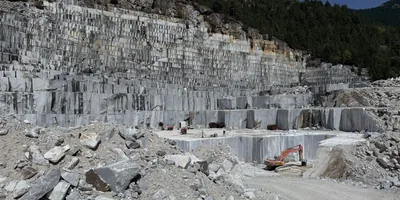
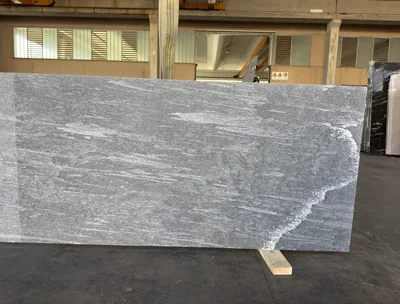
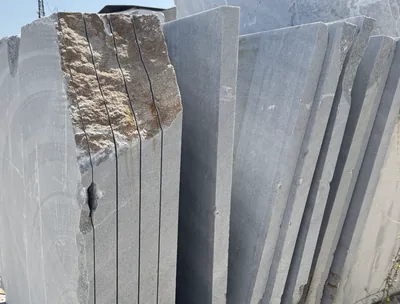
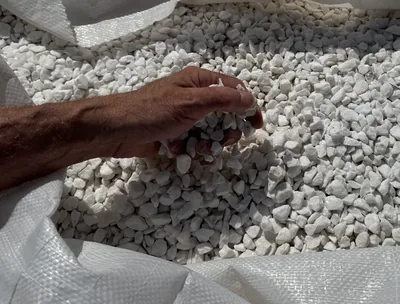
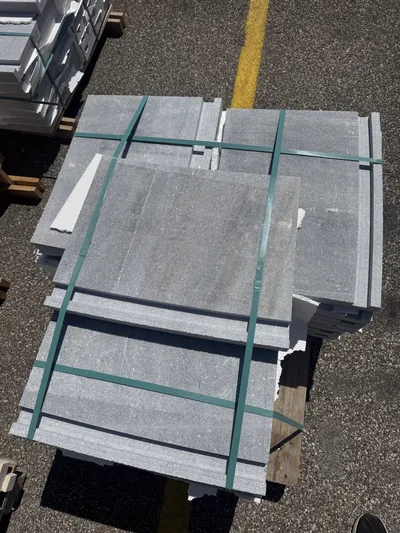
You will not find finished homes here. The work belongs to the contractor we built it for. What we show is the material and the process: the quarry, the stone, the finish samples, and the crates staged for the jobsite.
Hardscape questions
Bespoke exterior stone elements cut to a drawing: pavers, copings, steps and treads, pool surrounds, flagstone and puzzle patterns, fountains, planters and balustrades. Cut to format, with the finish the project needs. Not catalogue tile pulled from a stock list.
No. We supply the worked stone, cut to format, finished and crated install-ready. The compacted base, setting bed, jointing, sealing and the install itself are the general contractor's scope. We deliver the right stone at the right format, not the site package.
By density and water absorption, slip resistance, thickness by load, and durability under freeze-thaw, read against the relevant ASTM methods. A uniform dense stone often outperforms a soft veined marble outdoors. We speak to the test and the method, not an invented number.
As a lump sum with separated lines: FOB material and fabrication, ocean freight split East versus West, customs and inland. Never a flat dollar-per-square-foot that hides freight and duty. European sourcing carries a real floor; we state where our range starts rather than chase a commodity target it cannot meet.
The first step
Samples ship once the scope is agreed.